 Sorta
US + Canada
Milk Jugs in the Snow: A Beginner's Guide to Winter Sowing
Put seeds in a milk jug, abandon it in a snowbank, call it gardening. It works. Annoyingly well.
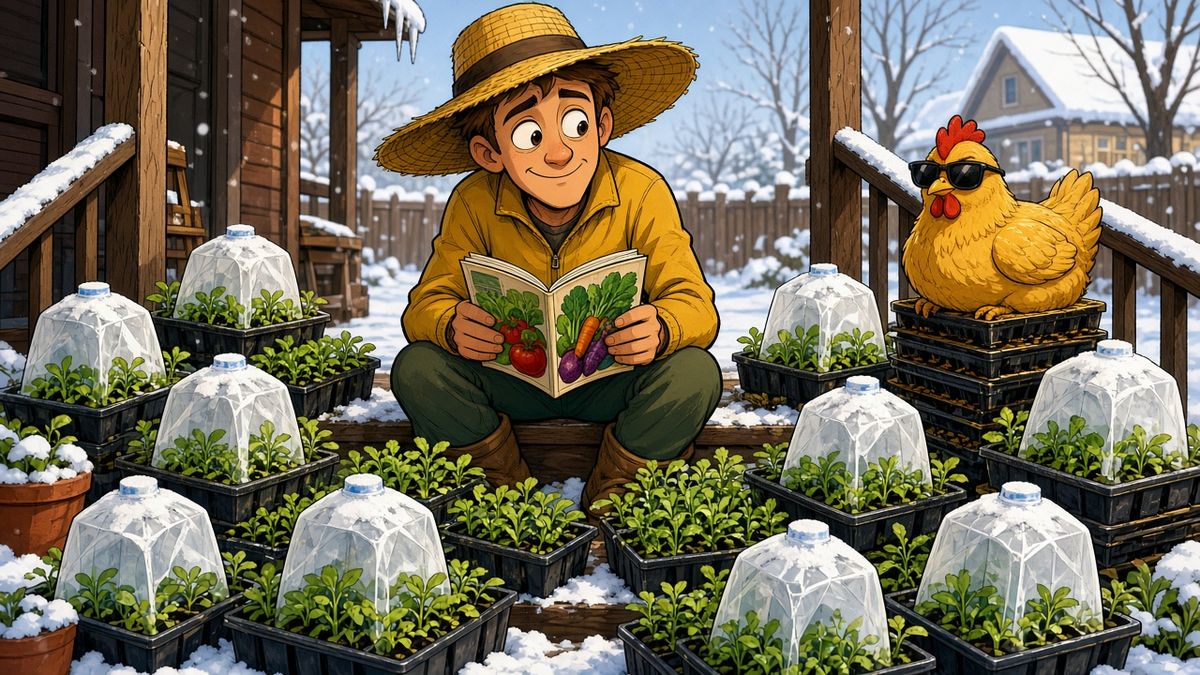
Apparently you can put seeds in an old milk jug, abandon it outside in the snow, and call it gardening. Meanwhile, half of us have a basement humming with grow lights, heat mats and a fan, like we're running a very suspicious, very small agricultural operation.
Turns out the milk-jug people are onto something. It's called winter sowing: the jug acts as a tiny greenhouse, winter's freeze-thaw cycles do the work a fridge would, and in spring the seedlings come up already tough enough for real weather. No lights. Less fuss before transplanting. Barely any effort, which is the best kind.
Here's how to do it, when to start where you live (US and Canada), and which seeds love it versus which will just sit there sulking.
So what's actually going on in that jug?
You sow seeds in a clear container with a few holes in it, set it outside, and walk away. Milk jugs, pop bottles and salad clamshells all work.
Winter does the rest. Plenty of seeds, especially native wildflowers, won't sprout until they've had a long, cold, damp spell. Gardeners call that cold stratification. It softens the seed coat and tells the seed winter is over. You can fake it in the fridge, or you can let actual winter handle it for free.
Meanwhile the jug keeps the seeds from washing away and keeps birds and bugs out of the buffet. It's cheap, it uses your recycling, it gives you a lot of seedlings, and it takes up zero room in the house. You can start as early as December or January.
Seeds that love it
- Native plants that need a cold spell. Some packets carry a code like "C30," which means the seed wants at least 30 days of cold.
- Perennial flowers, plus annuals that are cold tolerant or reseed themselves.
- The onion family.
- Frost-tolerant greens such as spinach and some lettuces.
- Herbs that self-sow: dill, cilantro and fennel.
Seeds that will just sit there sulking
Leave the tomatoes alone. Same goes for peppers, eggplant, squash, cucumbers and melons. They want warm soil to sprout, and a snowbank is not warm soil. Even tough crops like cabbage and broccoli sprout better in warmth, so don't put them out too early.
A lot of beginners get tripped up here, because many winter-sowing guides online are written by people in much milder places. The advice in this guide comes from a cold-winter state (South Dakota). If your winters are gentle, check with your local Extension office or provincial agriculture ministry before trusting a jug with your peppers.
When to put them out
In a cold-winter place like South Dakota, the rough timing looks like this:
- Native perennials: December to February, or as late as March where winters are colder. Start too late and the cold spell may be too short, and fewer seeds come up.
- Hardy annuals, perennials and vegetables: February to April, depending on your climate and the seed.
The longer and colder your winter, the more that "as late as March" end applies to you. If your winters are mild, don't borrow a cold-state calendar. Ask your state Cooperative Extension office (US) or provincial agriculture ministry (Canada) when local gardeners start seeds outdoors, and look up your frost dates (more on that below).
How to make a jug (nine steps, all easy)
- Wash the jug with warm, soapy water.
- Cut around it about 4 inches up from the bottom. Leave a bit uncut near the handle so the top swings open like a lid.
- Poke drainage holes in the bottom.
- Add 2 to 4 inches of seed-starting mix (the soilless kind) and wet it.
- Sow at the depth on the packet. Usually that's a thin layer of mix on top, unless the packet says the seed needs light to sprout.
- Tape it shut (zip ties or pipe cleaners work too), but leave the cap off so rain and snow can get in.
- Label it with the seed and the date. Some markers fade in the weather, so a tag tucked inside is a safe backup.
- Set it outside somewhere sunny and sheltered. A milk crate keeps it from blowing away. Tossing a little snow inside is fine; it's what would happen anyway.
- Transplant when the seedlings have two sets of true leaves or are about 2 inches tall.
Things nobody warned you about
- Native perennials can be slow. Like, months slow. If nothing's up by May or June, open the jug and keep it watered.
- A long, cold spring slows everything. Jug seedlings might not come up until May or June, and seeds started indoors can beat them to the garden. Winter sowing is easy, not always faster.
- Watch for late cold snaps. Once seedlings are up, a hard freeze can hurt them. Be ready to move the jugs into the garage for a night or two.
Your zone vs. the neighbours' zone
Here's a fun one: a Canadian zone 4 and an American zone 4 are not the same thing. The two countries build their maps differently.
| United States | Canada | |
|---|---|---|
| The map | USDA Plant Hardiness Zone Map (2023) | Natural Resources Canada hardiness zones (1991-2020, updated 2025) |
| What it measures | The average coldest night of the year, 1991-2020 | Several climate measures rolled into one number |
| The scale | Zones 1 to 13, each 10°F wide, split into "a" (colder) and "b" (warmer) | Its own numbered zones, plus a separate USDA-style map for Canada |
| Look yours up | Search your ZIP code at planthardiness.ars.usda.gov | Search your town at planthardiness.gc.ca |
If a catalogue lists USDA zones and you live in Canada, use the USDA-style Canadian map, not the regular one.
Frost dates matter more than zones. Your zone tells you what survives winter. Your frost dates tell you when to plant. Look up your average last spring frost and first fall frost: in the US through NOAA's climate normals or your state Extension office, and in Canada through Environment Canada's climate normals for your nearest weather station. One catch: an average frost date is a coin flip. Half of years, the frost comes later.
One thing to do this week
Pick three cold-tolerant seeds from the catalogue you've been hoarding and start one jug. Short on time? Cut and label all your jugs in one sitting, sow them the same afternoon, and let winter take it from there. After that, your whole job is to glance outside now and then and make sure nothing has blown into the neighbour's yard.
Somewhere under that snow, a seed is getting ready. Nice to be on the same team.
Sources & further reading
- Winter Sowing in the Northern Great Plains (R. Buterbaugh, SDSU Extension, updated Feb 26, 2024)
- Plant Hardiness of Canada (Natural Resources Canada)
- Canadian Climate Normals (Environment and Climate Change Canada)
- How to Use the Maps, USDA Plant Hardiness Zone Map 2023 (USDA ARS)
- USDA Unveils Updated Plant Hardiness Zone Map (USDA ARS, 2023)
- U.S. Climate Normals 1991-2020 (NOAA NCEI)