 Sorta
US + Canada
Seed Catalogue Triage: Don't Buy a Second Garden
Before you order 40 kinds of tomato: find out which of last year's seeds are still alive. Ten seeds, one paper towel.
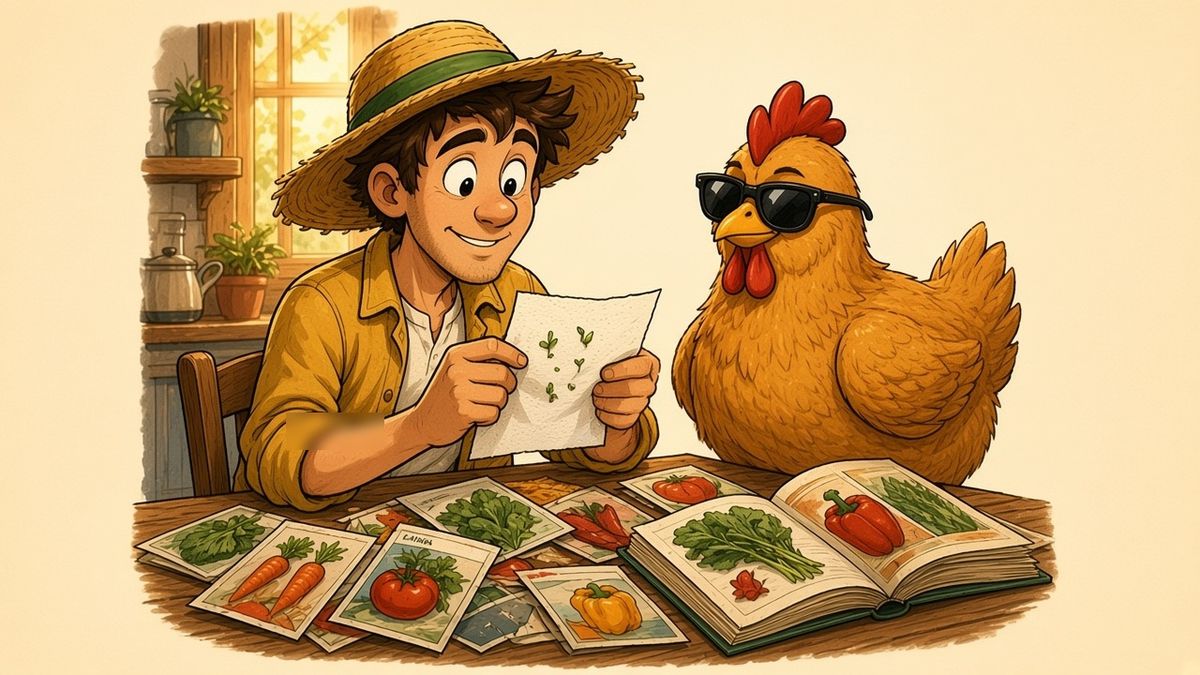
It's catalogue season: what feels like 400 varieties of tomato, each described like a love poem. Before you order, two things: go through the box of leftover seeds from last year, and give your wish list a ruthless edit.
Step 1: Raid what you already own
Good news: leftover vegetable seed usually keeps for another year with barely any drop in how well it sprouts, as long as it was stored somewhere cool and dry. Anything older than that needs a closer look.
How long seed lasts depends on heat, humidity and how dry the seed is, and it varies a lot from crop to crop. Cold and dry is the magic combination.
Here's a rough guide to how many years seed lasts when kept cool and dry:
- 1 year: onion, parsley, parsnip, salsify
- 2 years: pepper, sweet corn, okra
- 3 years: tomato, carrot, pea, snap bean, spinach, broccoli
- 4 years: beets, cabbage, kale, squash, pumpkin, Swiss chard
- 5 years: lettuce, cucumber, radish
- 6 years: leek
Those numbers come from some fairly old research, so treat them as a guide, not a promise. Which brings us to the fun part.
Step 2: Test it, don't guess
All you need is a paper towel and a little patience. Do this for any seed that's been sitting around for more than a year.
- Count out 25 or 50 seeds.
- Lay them between damp paper towels on a plate, and cover them so they don't dry out.
- Keep them somewhere around 70-75°F (21-24°C).
- Count the seeds as they sprout. Do a final count after two to three weeks.
- Work out the percentage. If it's bad, toss the seed and buy fresh.
If the number is lower but not terrible, the seed can still be useful. Just sow it more thickly than usual. One catch: weak seedlings die more often once they're in the ground, so don't expect miracles.
What counts as a good score? Seed sold in stores has to hit a minimum. In the US it's 70% for onion, 75% for tomato and 80% for lettuce. In Canada it's 75% for onion, 75% for tomato and 70% for lettuce. Those rules are for seed being sold, not seed you saved yourself, but they make a handy yardstick for your own test.
Canadian seed packets of most vegetables and herbs also have to show the germination percentage and the year the seed was tested. Check the year. That number tells you more than the pretty picture does.
Step 3: Triage the catalogue
This bit is our own method. Make three lists:
- Must: crops you actually eat and have grown before with success.
- Maybe: things that fit your season. Ignore the catalogue's zone map and compare "days to maturity" with the stretch between your last spring frost and first fall frost. In the US, look those dates up through NOAA's climate normals or your state Extension office. In Canada, use Environment Canada's climate normals for your nearest weather station. Remember that an average frost date is a coin flip: half of years, the frost comes later.
- Experiment: one new thing per category. One. Not eleven.
Then cross off anything already in your seed box that passed the paper-towel test.
This is where a lot of us get caught. It's January, everything sounds amazing, and the order quietly grows to three kinds of squash, five tomatoes and a melon that needs a longer summer than you'll ever get. Come spring there's no room, no time and a stack of unopened packets. If a seed isn't on one of the three lists, it doesn't go in the cart.
Buying seed across the border?
This is the one part where it pays to slow down, because the rules differ by direction and getting them wrong can cost you time and money.
Canadians ordering from a US catalogue: Small orders are usually simple. Canada lets gardeners bring in "small lots" without the import paperwork: under 5 kg of big seeds like peas, beans and corn, or under 500 g of small seeds like carrots. Most home orders fit easily. The seed still has to be free of weed seeds Canada prohibits.
That covers the seed rules, but other rules, like plant-health ones, can apply too. Most plants and plant products from the continental US don't need an import permit, but don't guess. Look up your specific item in the Canadian Food Inspection Agency's online tool (it's called AIRS) before you click buy.
Americans ordering from a Canadian catalogue: Going south is stricter. Every packet of seed for planting that comes from Canada needs paperwork: either a plant health certificate from Canada or a US "Small Lots of Seed" permit. The USDA actually suggests just buying your seed in the US.
If you still want that Canadian variety, the small-lots permit (form PPQ 587, applied for online through APHIS eFile) comes with conditions. For example: no more than 50 seeds or 10 grams of one kind per packet, no more than 50 packets per shipment, seed labelled and free of pesticide, and no tomato or pepper seed allowed under this permit. Getting it can take up to two months. Check the USDA APHIS pages below, or call their Plant Import Information Line at 877-770-5990, before you order.
Cheap-farmer note
Seed is one of the cheapest things in the garden, which is exactly why it's the easiest place to overspend without noticing. A paper-towel test is a pretty good use of a snowy afternoon.
There's something lovely about finding out last year's seeds still want to grow. Give them the chance.
Sources & further reading
- Vegetable Garden Seed Storage and Germination Requirements, G2090 (D.T. Lindgren and S.J. Browning, University of Nebraska-Lincoln Extension)
- Seeds Regulations (C.R.C., c. 1400), Schedule I, Table XX: minimum germination (Justice Laws Website)
- Importing small packet seed into Canada (Canadian Food Inspection Agency)
- ABCs of seed importation into Canada (Canadian Food Inspection Agency)
- Before you apply for a permit to import plants or plant products (Canadian Food Inspection Agency)
- Automated Import Reference System, AIRS (Canadian Food Inspection Agency)
- Canadian Climate Normals (Environment and Climate Change Canada)
- U.S. Climate Normals 1991-2020 (NOAA NCEI)
- Traveling into the United States From Canada at Land Borders: seeds (USDA APHIS)
- Seeds With Special Requirements and Prohibited Seeds: small lots of seed (USDA APHIS)